Wanted Win Account Guide: Registration, Verification and Account Rules
 Available in US
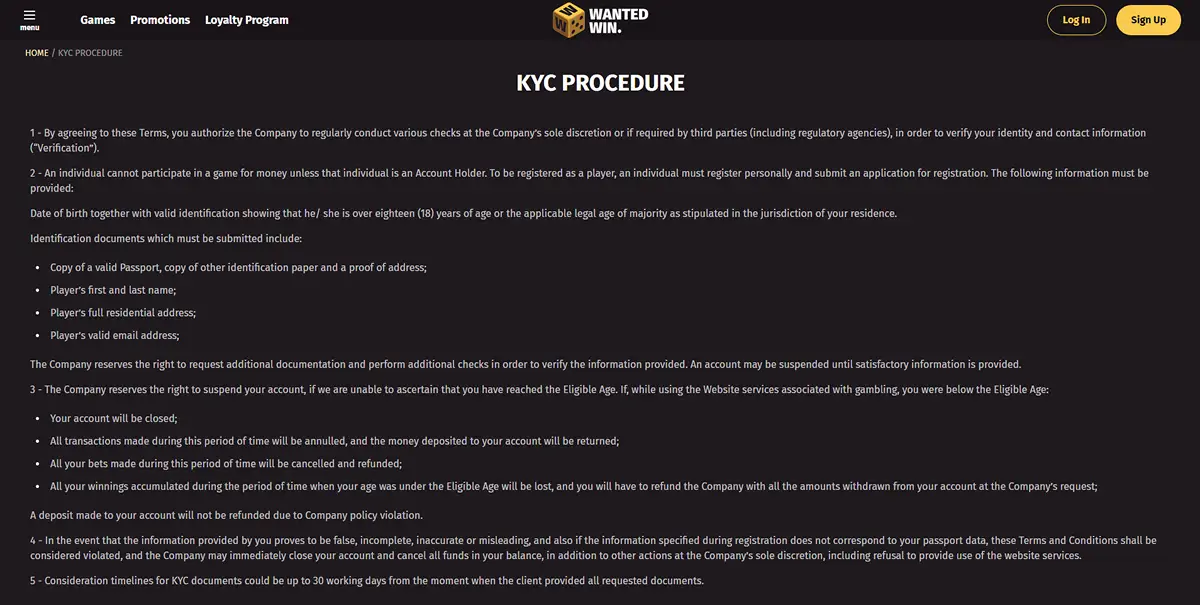
A Wanted Win account sits at the centre of registration, payments, verification and account-control settings. The current signup interface includes Australia in its country selector, and the operator’s terms require real-money account holders to be at least 18 years old or meet the higher legal age that applies in their jurisdiction. Identity verification can also be required, including checks against photo identification and proof of address.
Those interface and account rules should not be confused with Australian regulatory approval. ACMA states that providers must not offer prohibited online casino services to people in Australia, and it previously named Wanted Win in an ISP-blocking action. An Australian option in a signup form therefore describes what the brand’s interface presents; it does not establish that the service is licensed as an Australian gambling operator.

Table of Contents
- What the account page needs to answer
- Age and identity are core account conditions
- Australia in the selector: what it proves and what it does not
- How verification fits into the account lifecycle
- Payments are connected to account identity
- Responsible-gambling controls available on the account
- Account data should stay internally consistent
- The Australian legal context remains separate
- What to check before relying on the account
- Practical account checklist
What the account page needs to answer
The most useful way to assess a Wanted Win account is to separate the account lifecycle into distinct stages. Registration establishes basic credentials and account details. Verification checks whether the identity and contact information supplied can be supported by evidence. Payments connect the account to deposits and withdrawals. Responsible-gambling controls provide settings that can limit or pause activity. Each stage answers a different question, so treating them as one generic sign-up process can hide important distinctions.
For an Australian reader, the first distinction is between a brand-side interface and the local legal framework. Wanted Win’s form can present Australia as a country choice, while Australian law and ACMA enforcement address whether an online casino service may be offered to people in Australia. This account guide therefore explains how the account system is presented without treating registration availability as a statement of Australian authorisation.
The separate Wanted Win registration covers the signup interface and account fields, while the Wanted Win KYC guide explains document verification in more detail. Together, those stages show how registration and later identity checks fit into the account lifecycle.
Age and identity are core account conditions
Wanted Win’s current terms set an age threshold of at least 18, or the minimum legal gambling age in the user’s jurisdiction if that is higher. The same terms allow the operator to request proof of age and to suspend or terminate an account when age verification fails. Age is therefore not merely a checkbox displayed during signup; it is an account condition that can be tested against documentation later.
The verification framework also connects the account holder’s personal details to the identity evidence supplied. Wanted Win states that verification may involve government-issued photo identification, proof of current address and additional evidence when requested. Payment-method evidence can also be requested. The practical consequence is that the information entered during registration should be accurate and consistent with the documents and payment details that could later be used for verification.
This does not mean every account will be asked for the same documents at the same moment. Identity checks can be required, and the operator publishes categories of evidence it may request. The more specific question of document handling belongs on the KYC page rather than being duplicated here.
Australia in the selector: what it proves and what it does not
Australia appears in Wanted Win’s current registration country selector. That is useful evidence about the present interface because it shows that the signup form recognises Australia as a selectable country. It is not, however, evidence that an Australian regulator has licensed the casino or that every service shown by the website can lawfully be supplied to people physically present in Australia.
| Observation | What it supports | What it does not establish |
|---|---|---|
| Australia appears in the country selector | The registration interface contains an Australian country option. | An Australian gambling licence or local regulatory approval. |
| The terms contain an 18+ rule | Wanted Win applies an age condition to account holders. | That every Australian legal requirement is satisfied by creating an account. |
| Identity checks are part of the terms | The operator can request KYC evidence. | A guaranteed verification outcome or a fixed completion time. |
| Account controls are published | The brand offers tools such as deposit, loss, wager, cooling-off, self-exclusion and session limits. | That those tools replace Australian consumer-protection rules. |
This distinction prevents one of the most common account-page errors: using a selectable country as shorthand for licensing. The interface and the legal status are separate facts and should remain separate when assessing the account.
How verification fits into the account lifecycle
Wanted Win’s terms allow identity and contact-information checks to verify account eligibility and compliance. The published document categories include government-issued photo identification and proof of address, with additional or payment-related evidence possible when requested. Verification can therefore become relevant before a withdrawal or during other account checks.
From a decision-making perspective, this means the account should be created with details that can later be substantiated. A mismatched name, outdated address or payment method that cannot be connected to the account holder can create avoidable friction. The goal is not to predict exactly when a check will happen, but to recognise that the registration data, payment activity and verification evidence form one account record.
The dedicated verification requirements contains the document-focused detail, while the account overview concentrates on how KYC fits into registration, payments and withdrawals.
Payments are connected to account identity
Deposits and withdrawals are not independent of the account. A payment route can be available in the cashier while verification requirements still apply to the person who controls the account. This is particularly important at withdrawal because identity checks can be requested before funds are released.
The broader Wanted Win payments explains the verified payment categories and current AUD-oriented withdrawal rules. At account level, the useful point is simpler: payment details should be treated as part of the same identity and account-control system rather than as an anonymous transaction layer.
That approach also helps avoid over-reading the cashier. A working deposit method or AUD-denominated limit can describe the operator’s payment mechanics, but it does not answer whether the underlying casino service has Australian regulatory approval.
Responsible-gambling controls available on the account
Wanted Win publishes a set of personal account controls covering deposit limits, loss limits, wager limits, cooling-off, self-exclusion and session limits. These tools matter because they move responsible-gambling choices from general advice into settings that can affect account activity.
Deposit limits
Designed to cap how much can be deposited over the selected limit framework.
Loss limits
Designed to place a ceiling on losses rather than on deposits alone.
Wager limits
Designed to restrict the amount that can be staked.
Session limits
Designed to restrict time or session exposure.
Cooling-off
Provides a temporary break from gambling activity.
Self-exclusion
Provides a stronger account-level exclusion option.
The important account-management lesson is to choose controls before activity becomes difficult to manage, rather than viewing them only as emergency measures. These settings are brand-side tools. Their existence should not be presented as a substitute for local regulation or for external support services.
Account data should stay internally consistent
Registration details can become reference points later in the account lifecycle. The operator’s terms connect identity verification to information such as date of birth, legal name, residential address and email, and they allow further documentation to be requested. If account information changes, leaving old details in place can make later verification harder to interpret.
Consistency is especially relevant where payments and identity intersect. If a withdrawal check requires payment-method evidence, the account holder should expect the operator to compare the evidence with the identity attached to the account. This is one reason to avoid using another person’s identity or payment information and to keep account records accurate.
None of this guarantees that verification will be quick or that a transaction will be approved. It simply reflects how the published account rules connect the information supplied at registration with later compliance checks.
The Australian legal context remains separate
ACMA’s current guidance states that the Interactive Gambling Act 2001 makes it illegal for gambling providers to offer certain online services, including online casinos, to people in Australia. ACMA also named Wanted Win in a July 2024 blocking action after investigations found the service operating in breach of the Act. Those are regulatory facts about the provider-side legal framework, not instructions about how to create or access an account.
That distinction matters because the existence of a signup form can otherwise look like a regulatory conclusion. The safer interpretation is narrower: Wanted Win’s interface currently recognises Australia, while ACMA’s legal position and enforcement history must be evaluated independently.
For the full local analysis, see the Australian legal context. The Wanted Win licence separately covers operator licensing and trust signals.
What to check before relying on the account
When assessing the account, separate what is visible in the interface from what is guaranteed by the terms. The country selector is visible evidence about registration. The age rule and KYC framework are contractual account conditions. Responsible-gambling limits are published account tools. None of those points, individually or together, proves Australian licensing.
This layered reading makes the account easier to assess. It also reduces the chance of assuming that a smooth signup experience settles later questions about verification, withdrawals or regulation. Each stage has its own evidence and should be judged on that evidence rather than on the mere existence of an account.
Practical account checklist
- Use accurate personal information that can be supported by identity documents if verification is requested.
- Confirm the age requirement before creating a real-money account.
- Treat the Australian country option as interface evidence, not as proof of Australian licensing.
- Expect identity verification to be part of the account lifecycle, especially around withdrawals or compliance checks.
- Keep payment information consistent with the account holder’s identity.
- Review deposit, loss, wager, session, cooling-off and self-exclusion tools before they are needed.
- Use the dedicated registration and KYC pages for detailed stage-specific guidance instead of relying on a generic signup summary.
- Keep Australian regulatory status separate from whether a website form or cashier is technically available.
For a broader view of the brand’s games, bonuses, payments and regulatory context, return to the full Wanted Win review. The account itself is best understood as a linked system: registration supplies the initial information, verification tests that information when required, payments interact with the verified identity, and account controls provide ways to manage activity.
Prepared by the Wantedwin Casino editorial staff.