
Wanted Win KYC and Verification: Documents, Timing and Withdrawal Checks
 Available in US
Wanted Win can require identity verification before a withdrawal is processed and during other account checks. Its current terms list government-issued photo identification and proof of address as core evidence, while additional documents can be requested to confirm identity or a payment method. Withdrawal requests can remain pending until the required verification steps are completed.
Wanted Win’s dedicated KYC page states that verification review can take up to 30 working days. This is an official process statement, not a promise that every case will take that long, and no faster completion time should be guaranteed. The actual duration can depend on whether documents are readable and consistent and whether additional evidence is requested.
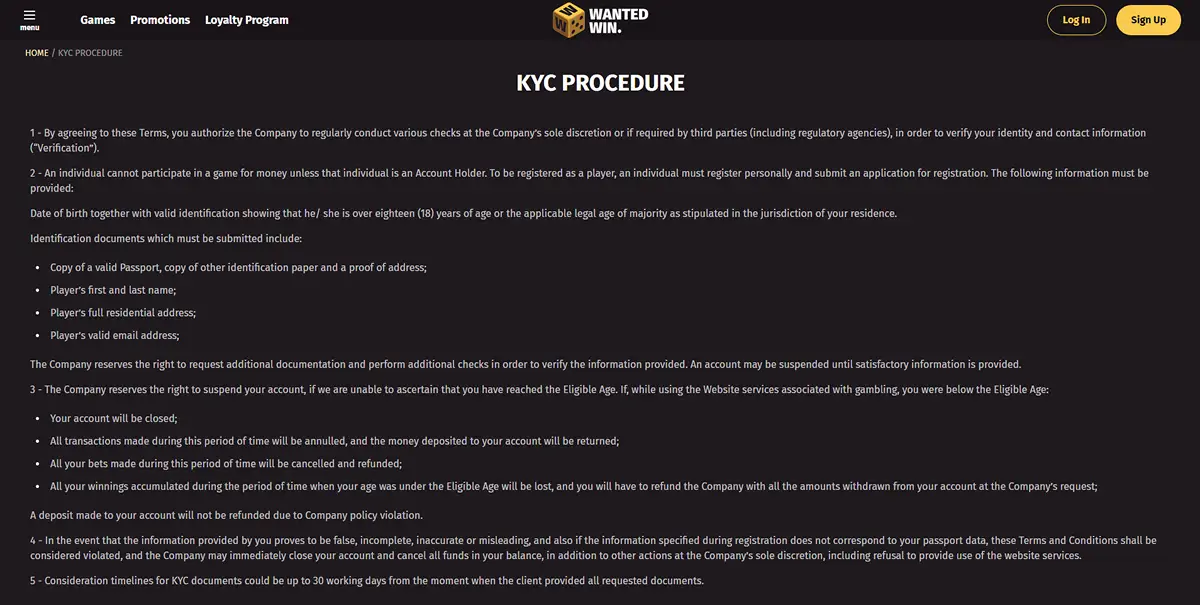
Table of Contents
- What Wanted Win can ask for
- Photo identification: what the published rules actually say
- Proof of address and why consistency matters
- Payment-method evidence can be requested
- How KYC interacts with withdrawals
- How long verification can take
- What can cause a verification problem
- A practical document-preparation sequence
- Verification checklist for Australian readers
What Wanted Win can ask for
The current Wanted Win terms give a clear baseline for verification. They name a valid government-issued photo ID, such as a passport or driver’s licence, and proof of current address, such as a utility bill or bank statement. They also allow the operator to ask for additional material when needed to verify identity or the payment method used on the account.
That structure matters because KYC is not just a single-document check. The first layer establishes who the account holder is. The second checks whether the registered address is credible and current. A third layer can connect the person to the funding or withdrawal method. In practical terms, an account can therefore require more than one document even when the basic identity evidence is valid.
The Wanted Win registration page explains why accurate signup details matter before any verification request appears. KYC compares later evidence with the information already attached to the account, so inconsistent names, addresses or dates of birth can create avoidable friction.
Photo identification: what the published rules actually say
Wanted Win’s terms explicitly mention government-issued photo identification. Examples include a passport and driver’s licence, and another section also refers to national ID. The important part is not the exact document label but that it is a valid official identity document capable of supporting the account holder’s name and age.
The terms also make age verification part of the wider account-control framework. A person must meet the site’s adult-age requirement, and the operator can request proof of age. This makes identity evidence relevant not only to withdrawals but also to basic account eligibility.
Expired, inaccurate or mismatched documents are a poor fit for that purpose. The terms allow account restrictions where requested information is not supplied or where the evidence is invalid. The practical approach is to use current documents whose details match the account record rather than treating verification as a last-minute upload exercise after a payout request.
Proof of address and why consistency matters
Proof of address is the second core category in the published KYC rules. Wanted Win gives examples such as a utility bill or bank statement. The purpose is straightforward: the document should support the residential address connected to the account.
This is where seemingly small account details can matter. If a player moved after registration, used an abbreviated address, or entered information that does not match the supporting document, the operator may need further evidence before it can complete the check. A clean verification file is therefore less about having a large stack of documents and more about having a consistent record.
Identity and address checks concern the account holder, not the operator itself. For operator and licensing details beyond KYC, see the Wanted Win licence guide.
Payment-method evidence can be requested
The current terms also allow Wanted Win to request evidence connected to the payment method. Elsewhere in the same terms, refund-related KYC examples include a payment-method image or account record. This confirms the broader principle that financial account ownership can become part of verification when the operator needs to connect a transaction to the registered customer.
The exact evidence depends on the method and the account situation, so there is no universal checklist that applies to every card, wallet or banking route. A card-based check, for example, is not automatically the same as an e-wallet check. The reliable rule is that additional payment evidence can be requested and that the operator expects the payment identity to be consistent with the account holder.
For the payment side of the process, see the Wanted Win withdrawals guide. That guide covers limits and payout mechanics, while the KYC material here stays focused on identity checks rather than repeating the withdrawal table.
How KYC interacts with withdrawals
Wanted Win’s terms state that the operator may verify identity before processing withdrawals. They also say withdrawal requests remain pending until required verification steps are complete. This is the key operational relationship between KYC and cashout: a withdrawal request can reach a verification gate before it reaches final payment processing.
The operator separately says it aims to process withdrawal requests within 72 hours of approval. That wording begins after approval and is not an end-to-end guarantee from the moment a withdrawal is submitted. If verification is still outstanding, the account has not necessarily reached the approval stage from which that processing target is measured.
This distinction is important when reading casino reviews that compress verification and payment into a single headline speed. There are really at least two stages: account or withdrawal review, and the payout processing stage after approval. A slow or incomplete KYC file can affect the first stage even if the operator publishes a processing target for the second.
How long verification can take
Wanted Win’s dedicated KYC page states that verification review can take up to 30 working days. The figure should be read as the operator’s published upper process statement for KYC, not as a guarantee that every account will take 30 working days to review.
The statement does not create a guaranteed faster turnaround either. Review time can depend on the documents supplied, whether extra evidence is requested and whether the submitted information matches the account. Claims of instant or automatic KYC approval would therefore go beyond the published timing language.
If verification is still pending, a withdrawal can remain pending until the required checks are complete. The separate 72-hour withdrawal-processing aim begins after approval, so it should not be combined with the KYC period into a single guaranteed end-to-end payout time.
What can cause a verification problem
Most document problems can be grouped into three categories. First is validity: an expired or otherwise invalid document may not satisfy the request. Second is mismatch: names, dates or addresses that do not line up with the account information can require further review. Third is incompleteness: supplying only part of the requested evidence can leave the account in a pending state.
The terms also allow additional checks, including contact verification in some circumstances. That means KYC should not be viewed as a fixed two-file upload that always ends the process. The operator can ask for more information where it believes that is necessary to establish identity or payment ownership.
The parent Wanted Win account guide places these checks in the wider account lifecycle. Registration establishes the record, verification tests it, and withdrawals can depend on the result. Keeping that sequence in mind makes the process easier to interpret than treating each step as unrelated.
A practical document-preparation sequence
- Check that the name, date of birth and residential address on the account are accurate before uploading anything.
- Use a valid government-issued photo ID whose identifying details are clear and current.
- Prepare a recent proof-of-address document that supports the residential address attached to the account.
- If Wanted Win requests payment evidence, provide the specific type of evidence requested for that method rather than assuming one format works for every payment route.
- Keep copies of what was submitted and note any request for additional information so the verification chain remains easy to follow.
- Do not interpret a pending withdrawal as a final payout-time estimate while KYC is still incomplete.
This sequence does not guarantee approval or a particular review speed. It simply aligns the evidence with the categories Wanted Win currently publishes and reduces the chance of creating avoidable inconsistencies.
Document presentation matters as well. A clear full-page image is more useful than a cropped corner that hides names, dates or address fields, and a legible scan is easier to assess than a blurred photograph. Where a payment method is involved, follow the operator’s request rather than exposing unrelated financial information. The goal is to provide enough evidence for the requested check while keeping unnecessary personal details out of the submission.
Verification checklist for Australian readers
- Expect government-issued photo ID and proof of address to be the core document categories.
- Be prepared for additional or payment-method evidence if Wanted Win requests it.
- Keep registered details consistent with the documents supplied.
- Assume a withdrawal can remain pending while required verification is incomplete.
- Do not treat the 72-hour post-approval processing target as a promise covering the KYC stage.
- Do not rely on claims of instant, automatic or no-KYC approval.
The strongest current conclusion is that Wanted Win operates a document-based KYC process that can directly affect withdrawals. The official terms support the core evidence categories and the ability to hold withdrawal processing until verification is complete. What they do not support is a guaranteed fast approval time. For the broader brand picture, return to the full Wanted Win review.
Created by the ”Wantedwin Casino” editorial team.